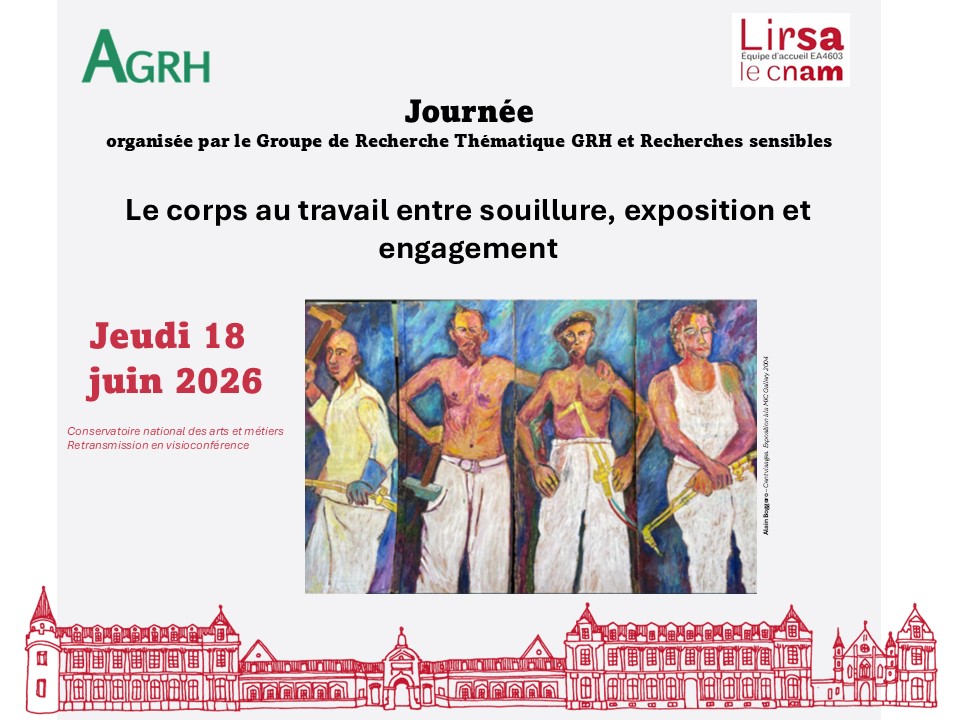
corpsouvriers : Le corps au travail entre souillure, exposition et engagement
Paris (France)
18-18 Jun 2026

corpsouvriers : Le corps au travail entre souillure, exposition et engagement
Paris (France)
18-18 Jun 2026
As Reyssat (2013) points out, ‘the question of the body in manual labour, in its phenomenological dimension (in the sense of work as a bodily lived experience), has […] received relatively little attention, whether in the sociology of the body or in the sociology of work’. However, an embodied approach to the body allows us “to uncover expressions of sensitivity, the nature of perceptions, and forms of physical engagement […] where constraint and freedom, submission and creativity intermingle” (Pillon, 2014, p. 151). From this perspective, the issue *Bodies at Work, Worked Bodies*[1] of the *Nouvelle Revue du Travail* (2019) highlights how bodies are simultaneously sources of energy, agents of action and products of social relations.
In this interpretation of the working experience among labourers and workers, the focus on defilement strikes us as significant. By definition, it refers both to physical dirt and forms of contamination, as well as to moral or symbolic attacks that devalue professions that are nonetheless essential. Everett C. Hughes’ concept of ‘dirty work’ thus refers both to professional activities deemed degrading, disgusting or humiliating—often at the bottom of the social ladder—and to certain less rewarding aspects present in all professional activities. Drawing on Mary Douglas’s (2005, the concept of dirt emerges as a social marker shaped by tensions specific to each society, oscillating between hygiene and defilement, rules and boundaries, order and disorder, life and death. Thus, ‘to speak of cleaning (tidying up) is to speak of dirt, but to speak of dirt is also to speak of cleaning’ (Reyssat, 2013, p.42).
This perspective invites us to reconsider the relationship between professional activity, the nature of the work, working conditions and the worker’s identity. The invisibility of jobs leads to the invisibility of the workers themselves. Workers are forced to redefine their contribution through strategies such as (re)valuation, resistance or economising on effort. Recent research sheds light on these dynamics: Legrand and Darbus (2023) reveal individual and collective ‘workarounds’ employed to cope with risks in SMEs, whilst Coëtard et al. (2025) reveal the construction of meaning at work in a context of dirty work and, in particular, a relationship to work that produces meaning and transforms the narrative of what individuals do and are. Exposure to stigma and strategies for restoring meaning illustrate Bourdieu’s ‘double truth of work’, namely that it is both a source of identity and a threat to the self.
HRM finds here a prime area to examine how it can “heal and rethink dirty work” (Boudaouine, 2022). How can we manage the paradoxical demands of performance and physical protection? To what extent is resilience in the face of the sometimes gruelling nature of these tasks taken into account within the management system (well-being, working conditions)?
The day is structured around three complementary levels of analysis. It begins by examining the body as a vehicle for socially devalued activities, through the occupations associated with ‘dirty work’ and the forms of paradoxical commitment they engender. It then broadens the discussion to the exposed body, considering situations where contamination takes on a biological, health-related or emotional dimension, putting organisational structures and management practices to the test. Finally, it offers a reflective examination of the researcher’s own body, engaged in the study of these sensitive fields and confronted with specific methodological, ethical and epistemological challenges. This exploration aims to capture the way in which bodies are simultaneously objects, instruments and mediators of work experiences, whilst shedding light on the tensions they crystallise for both individuals and organisations. From this perspective, HRM serves as a central theme for the day, in that it examines the organisational mechanisms capable of recognising, managing and transforming these bodily experiences of work, whether in the context of undervalued occupations, situations of exposure or sensitive research.
We would like to express our deep gratitude to all our partners for their vital support in organising this research day. Thanks to their commitment and financial contribution, we are able to offer a completely free event that encourages widespread participation and the open dissemination of knowledge.
AGRH, https://www.agrh.fr/
CNAM-LIRSA https://lirsa.cnam.fr/
Réseau Aprolliance (Cifre ANRT https://www.anrt.asso.fr/) https://www.aprolliance.fr/
Thank you to them
 Loading...